Well friends, today I usher in a new era of blogging for me. I have switched my blog from Blogger over to WordPress. Please excuse me as I learn the new interface but I sincerely hope you'll join me at my new site: http://adventuresofasaskatchewangirl.wordpress.com/. New posts and photos to come.
It has been an amazing four years blogging about my adventures in Australia and then my life back in Canada with Blogger. I look forward to sharing more of my adventures on WordPress. Thank you for always remaining my faithful followers.
xx,
Andrea
Saturday, January 5, 2013
Monday, December 31, 2012
Under construction
Merry Christmas and Happy New Year's friends! I'm going to hopefully be switching over to WordPress soon - I seem to have hit a photo wall in Blogger with Picasa and can no longer blog here for free. Stay tuned though....I'm hoping that it will be seamless transition! See you all again soon in 2013 :)
Wednesday, December 5, 2012
Sometimes recognition feels good
School has been keeping me occupied and eating my brain and time (I feel like) for the last year and a half. I embarked on the pursuit of my master's degree nearly two years to the day - handing in my application for the MACT program before the December 15 deadline. Little did I know what I was getting myself into.
There have been readings, group papers, online discussions, sleepless nights, frustration over APA formatting, laughter and probably too much alcohol consumed. My mind as been expanded by the material I've read, the friendships I've made with my classmates and how applicable my learning has been to how I do my job.
The end is near, I'm finishing my final two classes before starting my research project in January. God willing I will be wrapping up everything in August 2013 and graduating in November. It feels like this degree has gone on forever but today I received the best warm fuzzy ever (thanks Kate!) with this story on my research: Can LinkedIn be used to engage with alumni?
I'm so blessed and thankful to have a job, family and colleagues that have been so supportive during this time.
There have been readings, group papers, online discussions, sleepless nights, frustration over APA formatting, laughter and probably too much alcohol consumed. My mind as been expanded by the material I've read, the friendships I've made with my classmates and how applicable my learning has been to how I do my job.
The end is near, I'm finishing my final two classes before starting my research project in January. God willing I will be wrapping up everything in August 2013 and graduating in November. It feels like this degree has gone on forever but today I received the best warm fuzzy ever (thanks Kate!) with this story on my research: Can LinkedIn be used to engage with alumni?
I'm so blessed and thankful to have a job, family and colleagues that have been so supportive during this time.
Sunday, October 28, 2012
My new home
It's been just over a month since I moved out on my own and into a cosy little one-bedroom apartment. I'm still unpacking boxes and rearranging cupboards but for the most part this place now feels like home.


Still needing to hang some photos


This work area is atrocious!


I'm looking for baskets to go up top for mittens, hats and other miscellaneous things


Sunday, October 21, 2012
Birthdays!
Today is a day of milestone birthdays at either end of the spectrum. Today Mike and Angie's little baby Beck turns one! He had a birthday party yesterday and was as busy as any one-year-old can be. He's grown so much and gotten cuter by the day (if it's possible this kid can do it). What a change from when I first met him in November 2011!


 My grandfather also celebrates his birthday today. He turns 92 and in this day and age that is a true milestone. I'm going to call him at noon today and do the only thing I know I can to make his birthday brighter - play him "Happy Birthday" on the violin.


Beck last November at only a few weeks old

Yesterday Beck was totally into his yogurt


This is why I love my grandfather - Easter 2010 and he's playing MarioKart with us!

Happy birthday to my very "young" grandfather

I'd better brush up on this before I play Happy Birthday for him
Sunday, September 30, 2012
Peggy's Cove, Nova Scotia
Today is my last full day in Nova Scotia before boarding the plane and heading back to reality in Edmonton. I'm so sad to be leaving here.
For my final day in Halifax the conference organizers at #Influence12 organized a trip to Peggy's Cove for anyone who was interested. Peggy's Cove is one of the most photographed places in Canada and while tourism is a primary industry now for the tiny community, many of the inhabitants still fish for lobster. In 1998 tragedy struck the small community as Swissair Flight 111 crashed in the waters off of Peggy's Cove, killing all 229 on board.
As a last day to take photographs and spend time with my conference mates it was a magical day, despite the fog and cool wind. While there was work and learning accomplished during this trip, the connections and friendships I've made are well worth it.
The great news is I'm already planning my return out east. I have many friends to see and so much left to do. Thank you Halifax for showing me the best time!


For my final day in Halifax the conference organizers at #Influence12 organized a trip to Peggy's Cove for anyone who was interested. Peggy's Cove is one of the most photographed places in Canada and while tourism is a primary industry now for the tiny community, many of the inhabitants still fish for lobster. In 1998 tragedy struck the small community as Swissair Flight 111 crashed in the waters off of Peggy's Cove, killing all 229 on board.
As a last day to take photographs and spend time with my conference mates it was a magical day, despite the fog and cool wind. While there was work and learning accomplished during this trip, the connections and friendships I've made are well worth it.
The great news is I'm already planning my return out east. I have many friends to see and so much left to do. Thank you Halifax for showing me the best time!

At the top of the Seaport Farmer's Market (Georges Island in the background)


Peggy's Cove


Lobster Lane


Tribute to fishermen & family of Peggy's Cove at the deGarthe Gallery


Local artisans - Wharf Hags


Lots of lobster traps


The Old Red Schoolhouse

Peggy's Point looking in at the Sou'wester Restaurant


Peggy's Point lighthouse


Tiny cove (either Yankee or Eel - not too sure)


Author Ivan Fraser's front yard
Thursday, September 27, 2012
Halifax, Nova Scotia - Day 1
The lure of the east coast has been in the back of my mind for a long time and yesterday I finally got my first taste of all things maritime as I headed to Halifax, Nova Scotia. I was lured here for school first (I will present my master's research at a conference this weekend), but the beauty of Nova Scotia is the second lure, and may keep me here!
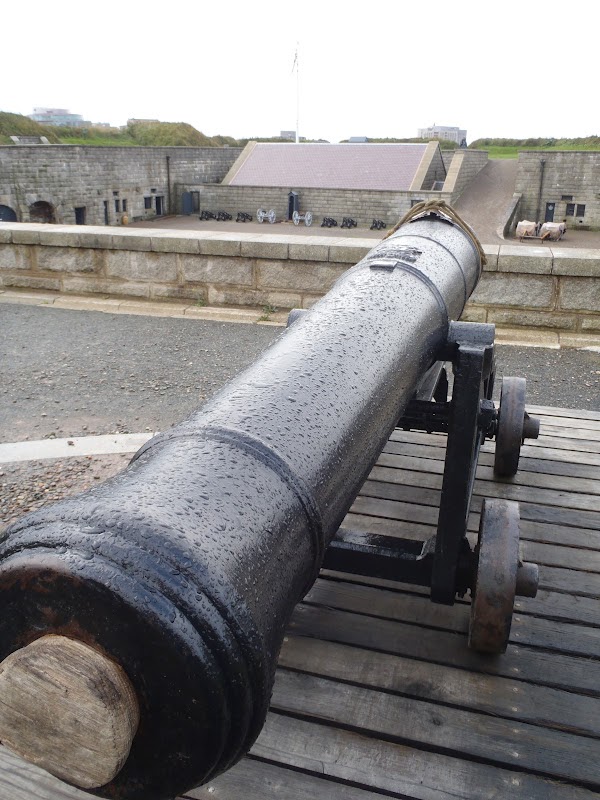
My first day was conference free and I took advantage of it to see as many sights as I could. Tops of the list is the Halifax Citadel, one of the oldest fortifications in Canada, 28 years in the making. I have long been in love with photos of this fortress and today I got to set feet on the walls, peer through the cannon holes and see the panoramic view of the Halifax harbour the Citadel protected. I happily spent a couple of hours wandering the walls and listening to the guided tours. My life is complete!


 But the fun didn't stop there. I wandered further up the hill and inland to the Public Gardens in the heart of Halifax. This large green space emulates Victorian gardens of the day. With the proximity to both St. Mary's and Dalhousie universities, the space was full of students strolling, sitting, studying and feeding the ducks. It was a beautiful lunch-time stop for me.


 I headed back towards the waterfront, my sights set on Pier 21 - one of the first immigration posts people encountered when heading to Canada from the 1800s to 1960s. On the way I couldn't help but snap some photos of the colourful Halifax housing.


 Once I arrived at Pier 21 my mission was to see if I could find the landing records of my great-grandfathers' William "Scottie" Lauder and Albert Brunsdon. As luck would have it I was able to find records of them both. Printed copies safe in my luggage I know my parents will both be thrilled to have one more piece of their ancestry revealed.


Finally I was ready for a little fun, and something to wet my whistle so I walked along the waterfront and eventually came to the Alexander Keith's brewery. Around since the early 1800s Alexander Keith's is an institution across Canada but no more so then in the home brewing town of Halifax. Still brewing from it's original location we were treated to a campy, acted out tour complete with singing, dancing, storytelling and of course - beer!


 The day wasn't quite finished as I connected with my friend Monica for dinner and more beer. I met Monica this summer in Vermont and she is enthusiastic to show me her hometown. I feel more adventures are to come!
I'm a tired panda tonight and should get some zzzzz's soon. Tomorrow is my day to present but I'm ready for the challenge. Stay tuned for more pictures and stories :)
My first day was conference free and I took advantage of it to see as many sights as I could. Tops of the list is the Halifax Citadel, one of the oldest fortifications in Canada, 28 years in the making. I have long been in love with photos of this fortress and today I got to set feet on the walls, peer through the cannon holes and see the panoramic view of the Halifax harbour the Citadel protected. I happily spent a couple of hours wandering the walls and listening to the guided tours. My life is complete!




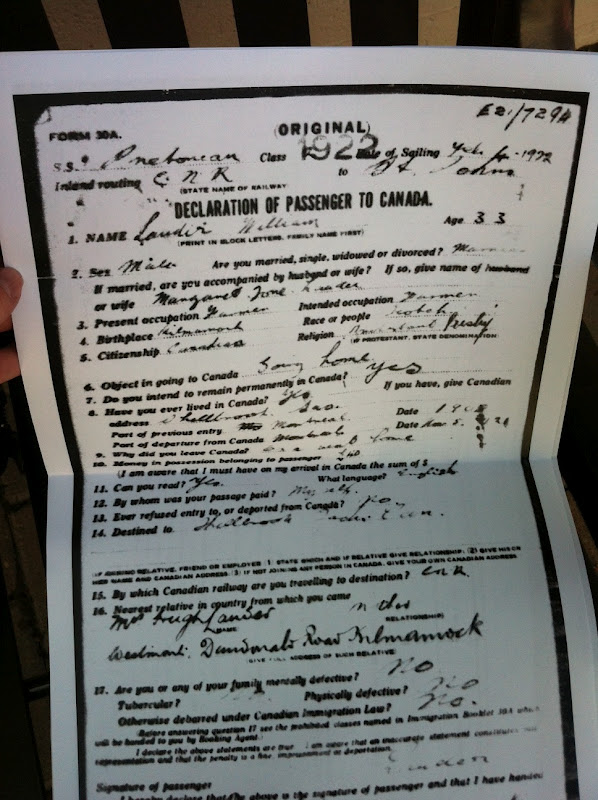
The landing papers for my great-grandfather William "Scottie" Lauder

Alexander Keith's brewery!


A little song with our ale

Rumor is Mr. Keith built this exact tunnel between his house & the brewery

I'm a tired panda tonight and should get some zzzzz's soon. Tomorrow is my day to present but I'm ready for the challenge. Stay tuned for more pictures and stories :)
Subscribe to:
Posts (Atom)